
Documents in Adair County Deed Records
The Adair County Clerk land-record menu covers deeds, mortgages, plats, liens, releases, wills, condominium records and related filings. Each instrument does different legal work. A deed records a transfer or claim of interest. A mortgage secures debt. A release can clear all or part of a recorded burden. Reading the document type before the names prevents a common mistake. Treating every filing as a sale leads readers of Adair County deed records astray.
| Deed Type | What It Does | Common Use |
|---|---|---|
| General or warranty deed | Conveys the stated interest with deed warranties | Ordinary voluntary transfer |
| Quitclaim deed | Conveys only the interest the grantor may hold | Clearing or changing an existing claim |
| Correction deed | Corrects a cited prior instrument without a new conveyance | Fixing an error in the record |
| Contract for deed | Sets a purchase contract while the seller retains title until completion | Installment purchase arrangement |
| Easement or release | Creates access rights or releases a recorded burden | Utility, access or lien questions |
Adair County deed records show what reached the recording office. They do not prove that no outside claim exists. For a question involving marketable title, read the instrument alongside later corrections, releases, assignments and court filings. The full record tells the story.
Easements deserve their own check. The clerk indexes them under the parties and each affected parcel. A partial mortgage release needs the affected property's description. A whole release points back to the original mortgage book and page. Stopping at the newest deed can therefore miss an access right or burden. That right or burden may still attach to the same parcel of land.
Adair County Deeds Begin in Suite 3
Lisa Greer is the Adair County Clerk. She serves as the recording custodian at 424 Public Square, Suite 3, in Columbia. The office lists weekday hours from 8 a.m. to 4 p.m. It also opens the first and third Saturdays from 8 a.m. to 11 a.m., subject to holiday closures. Call 270-384-2801 or 270-384-4007 before a special trip. The PVA occupies Suite 2 at the same address. It keeps assessment and parcel records, not the deed books.
Arrive with a PVA map number, legal description, or owner spelling. A known deed book and page works too. Ask the clerk a simple question first. Does the request need a current book, an older index, or archival help? Adair County publishes no public grantor-grantee web index and states no online cutoff. The counter is a primary access channel, not a mere backup for the deed records.
Note: The clerk and PVA share 424 Public Square, but their records and suite numbers stay separate.
What Every Adair County Deed Carries
The clerk's recording instructions require far more than two party names. Every Adair County deed needs the grantor and grantee with mailing addresses, a consideration statement, legal description, source of title, preparation statement, return-mail address, and the address used for the tax bill. The grantor's signature is notarized, as are the required consideration-statement signatures.
- Grantor and grantee names and mailing addresses
- Consideration or an applicable exempt statement
- Land description and prior source-of-title reference
- Preparation and return-mail information
- In-care-of tax address required since August 1, 2008
Every Adair County deed gets recorded where the land sits. That rule holds even when a parcel straddles a line. The filing goes to the county holding the greater part. Kentucky's transfer tax, set out under KRS 142.050 and described by the clerk, runs fifty cents per five hundred dollars or fraction. Listed exemptions apply. Treat that figure as part of the recording paperwork. It is not a fresh appraisal of the parcel.
Follow Adair County's Grantor-Grantee Chain
A grantor transfers an interest in the land. The grantee receives it. A chain of title is simply those transfers lined up in order, and each instrument links one holder to the next. Working Adair County deed records means walking that line backward, grantee by grantee. The trail eventually runs out. The source-of-title clause in a current deed helps most. It should cite the earlier book and page where the grantor first took the interest.
- Identify the current parcel through the Adair PVA, then carry its map number and legal-description clues to the clerk.
- Locate the latest deed and record its grantor, grantee, execution and recording dates, deed type, book/page and source title.
- Search the named grantor as an earlier grantee. Compare the description, acreage, adjoining owners and subdivision terms before accepting a match.
- Repeat through each source-title reference. Move to physical books, microfilm or KDLA when the local index route changes.
- Grantor
- The party transferring the stated interest.
- Grantee
- The party receiving the stated interest.
- Chain of title
- The linked sequence of transfers for the same land.
- Book and page
- The volume and page coordinates used to retrieve a recorded instrument.
Adair County Deeds Reach Into 1802
The Kentucky Department for Libraries and Archives inventory carries Adair deed records from 1802 through 1998. That span covers the archive's holdings. Digitized pages are another matter. The clerk's current online coverage stands on its own. KDLA also lists Adair wills from 1804 through 1999 and county orders from 1802 through 2011, companion trails worth checking whenever an estate or court action breaks a clean deed chain.
The archive's method is direct. Find an index entry first. Then note the book and page. Then read the entire instrument for parties, dates, consideration, the property description, signatures, and clerk certification. Requests go to KDLA online or by mail, with an estimated turnaround of four to six weeks. The archive lists a nonrefundable search-and-copy fee of $20 for Kentucky residents and $25 for out-of-state requesters, plus applicable copy, scan, and postage charges.
Note: An indexed entry is a finding aid, not a promise of a downloadable Adair deed image.
Plat Clues Unlock Adair County Deeds
A Kentucky utility filing shows how tightly one tract's paper trail can be stitched together. Parcel 063-00-00-055.00 traced back to Turner Heirs Farm Division Lots 1 and 2, Plat Cabinet 4, Slide 131, a Green Hills Subdivision boundary, Deed Book 340 page 241, and an older reference at Deed Book 93 page 322. Every one of those is a retrieval clue. None of them is an ownership finding by itself.
Subdivision names change with addresses, but labels like farm division, addition, tract, lot, and amended final plat tend to persist in the deed records. Keep the parcel punctuation intact. Keep every cabinet and slide reference too. The clerk's plat page notes that recorded plats need planning approval under KRS 100.283, along with dated approval and a sealed surveyor certification. The plat fixes the geometry; the deed carries the conveyance. Together they identify the land.
Correction deeds deserve special care. The clerk's instructions call for the same original grantor and grantee, a reference to the first instrument, and a stated reason for the correction. That filing is not a second sale. A quitclaim likewise transfers only what the grantor might own, with no warranty, so treat its place in the chain as a prompt to read the surrounding instruments closely.
Verify Adair County Recording Fees
The clerk's posted land-record fee schedule carries a 2020 label. It also carries a warning that amounts may vary. It lists $50 for a deed, easement, lease, plat, or power of attorney. A mortgage runs $80. A release, correction, or assignment runs $46. Treat those numbers as planning leads. Ask for the current total, any page or indexing surcharges, the copy type, and accepted payment before you file a document or order a copy.
Written requests are a real access path for Adair County deed records. No web index exists. Review the county's open-records request route and draft a narrow one.
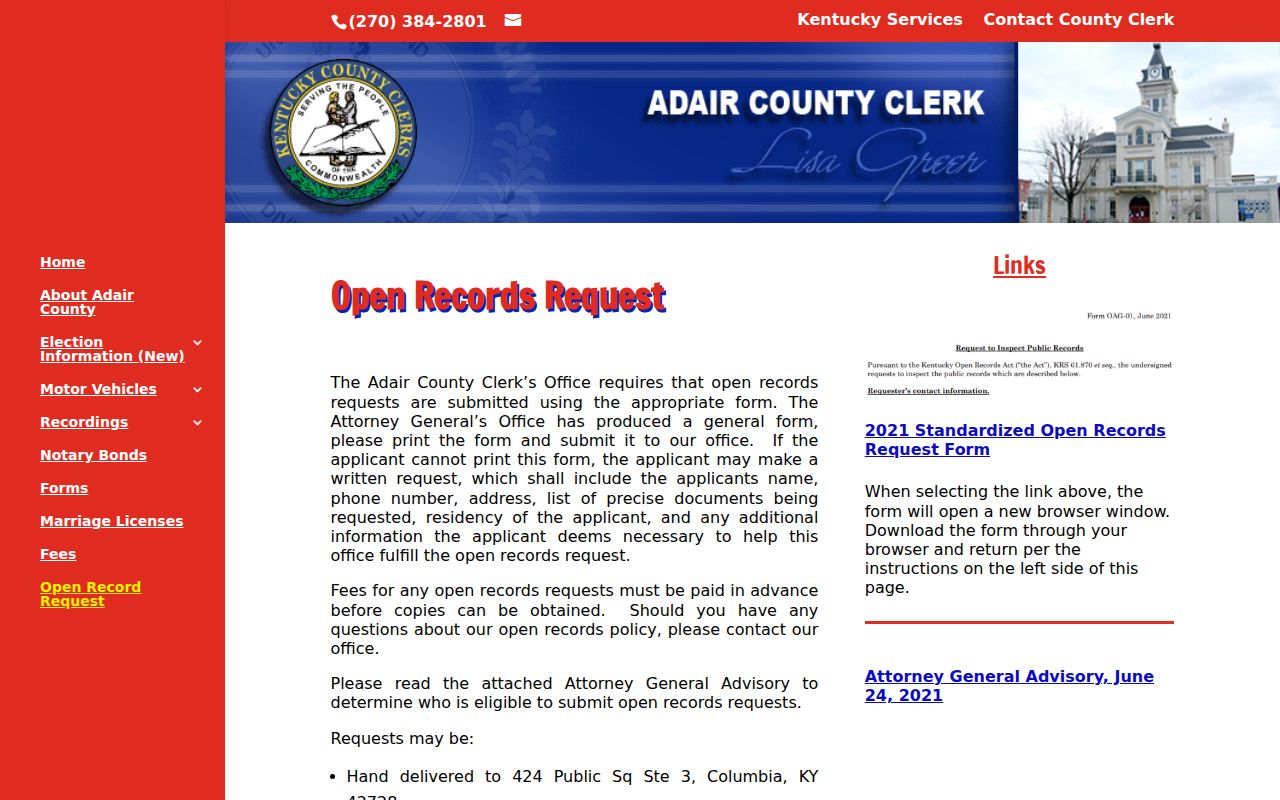
A written request is a genuine route to Adair County deed records. This applies when an online index is absent. It is not a stand-in for a full title search.
A good copy request separates retrieval facts from legal conclusions. Give the grantor, the grantee, and an approximate recording date. Include the deed type, the parcel number, and the book and page if known. If a source title reference is your only firm clue, quote it exactly. Ask staff to confirm the copy format and total before you pay. A certified copy carries the clerk's certification. An ordinary copy usually serves preliminary work. However, the receiving court, lender, or professional sets the standard for formal use.
A phone call can sharpen an uncertain citation before you commit anything to writing. Mail, email, and fax remain documented channels under the clerk's open-records procedure. A counter visit opens the office's finding aids directly. The county publishes no public online deed index. So none of these channels replaces the others. Plan accordingly, especially for a broad surname or multi-generation search through Adair County property records.
Request an Adair County Deed Copy
Visit the Adair County Clerk counter. You can also call the office, or send a focused Kentucky Open Records Act request. The clerk takes requests by hand, mail, email, and fax. Your request should include your name, phone, address, and Kentucky residency. It should then identify the exact record with names, a date range, the parcel number, instrument type, and any known book and page. Fees are paid in advance. The office allows five business days to respond, excluding weekends and legal holidays.
KORA, KRS 61.870 through 61.884, lets Kentucky residents inspect or copy public records. A signed written request that meets the standard cannot be rejected. It cannot be turned away just for lacking a special form. Ask whether an ordinary copy or a clerk-certified copy suits your purpose. For older material, send the same identifiers in a KDLA request. The Adair County property search can establish the parcel number. Do that before you ask for the deed.
Estates can hide part of the story. A will, probate order, executor instrument, or other fiduciary document may supply the authority. That authority sits behind the next transfer in the deed records. A lis pendens, quiet-title case, or foreclosure order can also shift the sequence. Search those companion records only when a deed references them or a gap needs explaining. Keep each court case number beside its related recording citation.
Recorded, not guaranteed. Adair County deed records show filed instruments, not a title opinion. Unrecorded interests, later court orders or indexing errors may still affect the land.